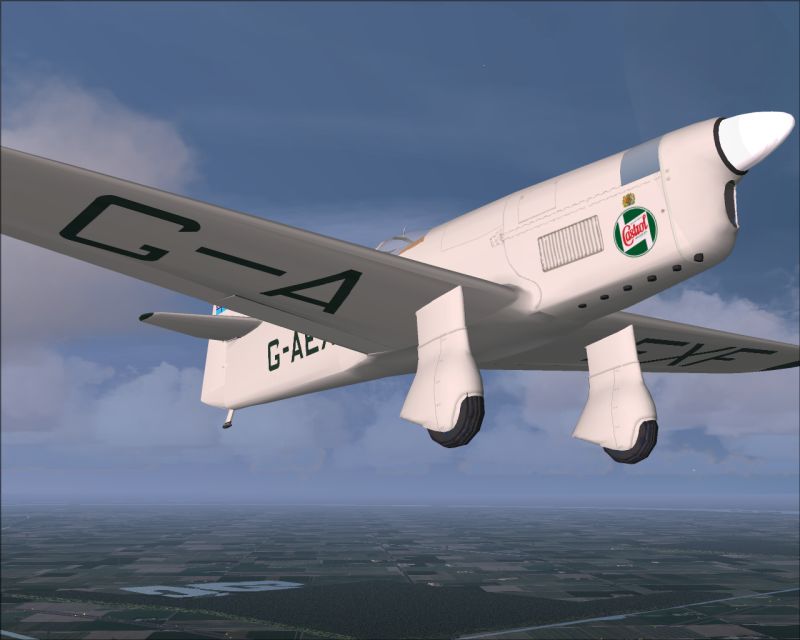
Nice one Souichi.

When was that Charlie? I assume it was at Old Warden. If I'm not mistaken the last time I saw EXF was at at fly-in at Wroughton some years ago. I don't remember who owned it then but I should have shots of it somewhere. Perhaps you can fill in the gaps. According to this it's now with RACo at Breighton.
http://www.realaero.com/index.htm
It was back in the late 90s at Old Warden Doug - At a push it may have been 2000. I seem to remember that RACo took it to Reno the year after they bought it from Desmond Penrose, so it must have been 2001-2002 that it left Old Warden (15th June 2002 upon checking)...
It's had in interesting history, I was going to mention in my previous post that I thought it had spent the war in France, and that's confirmed here...
[quote]Percival E.2H Mew Gull G-AEXF
The Percival E.2H Mew Gull (G-AEXF) was built for air racing, it is one of only six examples built and the sole survivor of those six. In 1938 this very aircraft achieved a staggering 270 mph, faster than the Hawker Hurricane at sea level. Between February 5th and February 9th 1939, air race pilot Alex Henshaw, flying this specially modified Percival E.2H Mew Gull, set a number of records for solo flight between Gravesend London and Wingfield Cape Town, many of which still stand to this very day almost 65 years later.
Henshaw's epic flight to the Cape and back is regarded by many as being one of the most amazing feats of airmanship, navigational skill and human endurance. He spent in excess of sixty hours airborne over a period of only a hundred and three hours and travelling at an average speed on the outward leg of 209.44 mph. The demands on both the pilot and aircraft were enormous, he made ten takeoffs, the majority from very poor airstrips whilst dangerously overloaded with fuel. To compound these difficulties, the aircraft suffers from very poor forward visibility making landing and taking-off a challenge at the best of times but almost impossible during the hours of darkness, yet amazingly, four takeoffs were made at night.
Pilot fatigue, atmospheric haze, thunderstorms, ice, fog and darkness ate into what remaining margin for error Henshaw may have believed he had. Against all the odds, 39 hours and 23 minutes after leaving Gravesend, after negotiating desert and jungle landscape largely devoid of landmarks, suffering an attack of malaria and a partially severed finger, he landed at Cape Town, a total distance of 6377 miles. The return trip to London was completed in the slightly slower time of 39 hours and 36 minutes.
In addition to the Cape records, Alex Henshaw and G-AEXF hold the fastest ever Kings Cup victory, achieving an average speed of 236.25 mph over a triangular course of 1012.14 miles.
Henshaw sold his Mew Gull to Frenchman Victor Vermoral in 1939. Hugh Scrope eventually retrieved the aircraft from France and, with his engineer Doug Bianchi, made valiant efforts to keep the aircraft operational. Unfortunately it was damaged during a landing accident and later acquired by Fred Dunkerly. Modfications were carried out with the intention of improving forward visibility and, despite being ugly and disfiguring, 'XF won the 1955 King's Cup, albeit at a speed of 213.5 mph, 23 mph slower than in 1938. The Mew Gull continued its racing career until August 1965 when the engine failed, forcing a hasty emergency landing by owner/pilot Ernie Crabtree who subsequently donated the aircraft to an ill-fated air museum in Blackpool.
In 1971 the museum went into liquidation with a number of airframes being offered for sale, including a much neglected 'XF. Tom Storey and Martin Barraclough bought the mortal remains for


 by Souichiro » Fri Sep 30, 2005 1:40 pm