Pole to pole! part 3
 Posted: Fri Sep 02, 2005 12:18 am
Part 2 is here.
Day 3
Day two was spent in idleness; as Edward spent the day with the scientists of Resolute Bay.He's always been fascinated with weather; though he's just more interested in what other people do, I think.
Day Three dawned with zero-visibility conditions in heavy sleet and wind. It was clear we wouldn't be going anywhere. Fortunately for us; the weather finally cleared around 5:00pm. Considering that aircraft would have to be cleaned and deiced; I had decided to cancel the flight until day four; since we wouldn't be done deicing YYZ until after dark.
And thus began the first of many arguments between myself and Edward: He wanted to go on. Both he and I are highly experienced night fliers; and the DC-3 is solid and dependable. The ground we'll be flying over is largely open; so we don't need to worry about the mountains farther into the mainland. In addition; we'll be able to use several NDB's along our route to keep our position fixed; and our final destination - Norman Wells (CYVQ) has both NDB and VOR to home in on.
Those were Ed's arguments. And don't get me wrong; I respect them, the man has been flying since the late 30's. YYZ, you must remember, was his aircraft back when it was part of the WTA fleet.
However; I know the Arctic. Nothern bush flying is 'my thang'; and I'm all too familiar with what can happen up here. NDB's can be lost; the all-important compass is unreliable, and the gyro drifts alarmingly. This time of year; visibility is a crucial factor as well. I'm also all too familiar with what losing an airplane is like. I argued - strenuously - against night flying. I'm generally against suicide.
However; Ed was not to be deterred. His say is final; and though he rarely uses it; he used it here. So with my misgivings; we boarded, started up and headed off into the weirdest night flight I've ever undertaken.
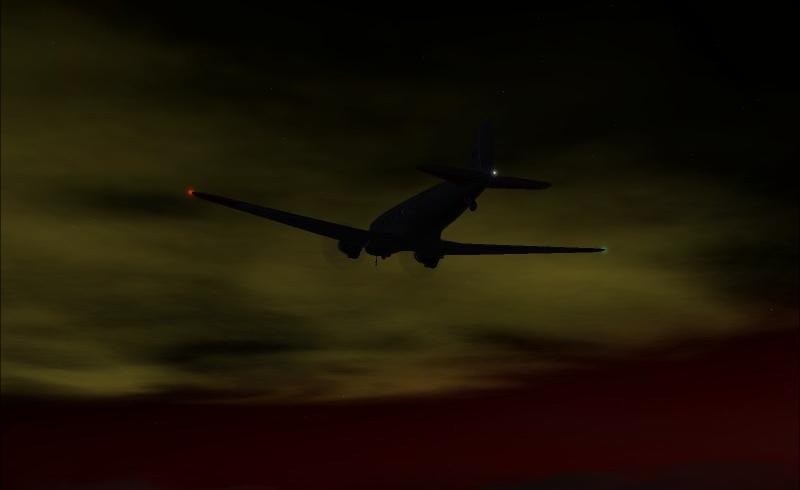 Climbing into the dark; the Northern Lights overhead.
The flight was, in a word, scary. Heavy turbulence through most of the flight; 100% cloud cover for the rest. Even after climbing through 13,000ft. (and dealing with a nasty case of icing as a result) we were unable to locate any NDB beacons. In the Arctic (as I'd tried to explain to Ed) they don't function after dark.
Well; you do what you can. Dropping back down to a more comfortable 9,000ft; there was enough moonlight to locate our target lake and lay a course over it. Upon reaching the western edge; we managed to pick up the Norman Wells VOR and rode the beam into the airfield. Without DME; we were only able to guess how far it was; so while I flew Ed stayed busy with his pencil; keeping me updated on probable ETA's.
We finally saw the field as a mere glimmer through heavy clouds. A steep dive through the frigid night air; a rocky landing, and we were down; taxiing to the pumps.
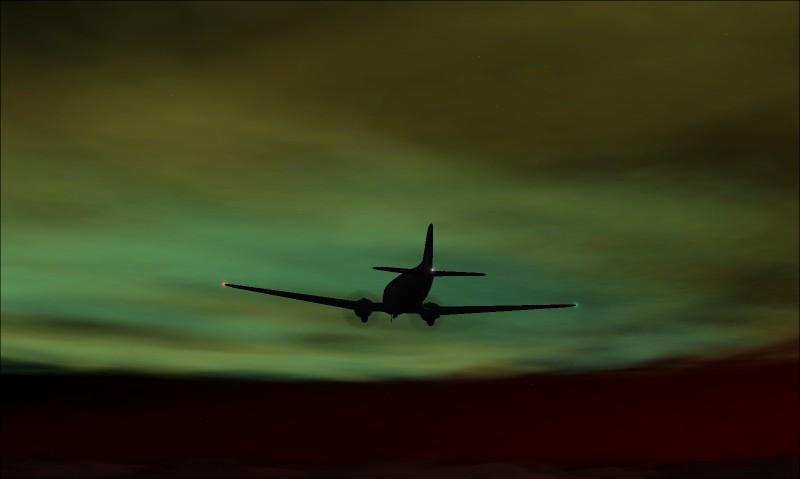 Flying under the Lights. Very pretty; but unnerving, since they offer no groundlight and blind you to ground features.
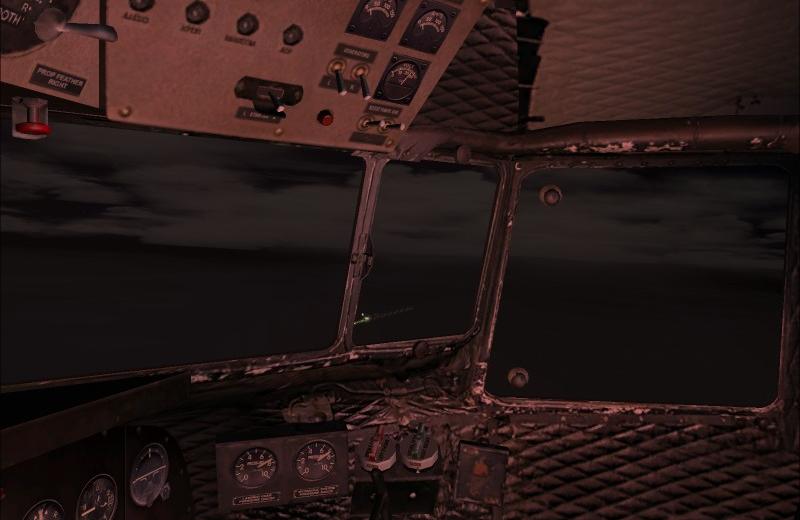 On a steep base leg for Norman Wells. Procedure for the DC-3 in these conditions can best be described as "This looks about right!
  "
"
This time; after fuelling up even Ed didn't feel like pushing our luck and repeating that flight; so we stretched out in the back for a nap to wait for daylight.
Part 4 is here.
Day 3
Day two was spent in idleness; as Edward spent the day with the scientists of Resolute Bay.He's always been fascinated with weather; though he's just more interested in what other people do, I think.
Day Three dawned with zero-visibility conditions in heavy sleet and wind. It was clear we wouldn't be going anywhere. Fortunately for us; the weather finally cleared around 5:00pm. Considering that aircraft would have to be cleaned and deiced; I had decided to cancel the flight until day four; since we wouldn't be done deicing YYZ until after dark.
And thus began the first of many arguments between myself and Edward: He wanted to go on. Both he and I are highly experienced night fliers; and the DC-3 is solid and dependable. The ground we'll be flying over is largely open; so we don't need to worry about the mountains farther into the mainland. In addition; we'll be able to use several NDB's along our route to keep our position fixed; and our final destination - Norman Wells (CYVQ) has both NDB and VOR to home in on.
Those were Ed's arguments. And don't get me wrong; I respect them, the man has been flying since the late 30's. YYZ, you must remember, was his aircraft back when it was part of the WTA fleet.
However; I know the Arctic. Nothern bush flying is 'my thang'; and I'm all too familiar with what can happen up here. NDB's can be lost; the all-important compass is unreliable, and the gyro drifts alarmingly. This time of year; visibility is a crucial factor as well. I'm also all too familiar with what losing an airplane is like. I argued - strenuously - against night flying. I'm generally against suicide.
However; Ed was not to be deterred. His say is final; and though he rarely uses it; he used it here. So with my misgivings; we boarded, started up and headed off into the weirdest night flight I've ever undertaken.
Climbing into the dark; the Northern Lights overhead.The flight was, in a word, scary. Heavy turbulence through most of the flight; 100% cloud cover for the rest. Even after climbing through 13,000ft. (and dealing with a nasty case of icing as a result) we were unable to locate any NDB beacons. In the Arctic (as I'd tried to explain to Ed) they don't function after dark.
Well; you do what you can. Dropping back down to a more comfortable 9,000ft; there was enough moonlight to locate our target lake and lay a course over it. Upon reaching the western edge; we managed to pick up the Norman Wells VOR and rode the beam into the airfield. Without DME; we were only able to guess how far it was; so while I flew Ed stayed busy with his pencil; keeping me updated on probable ETA's.
We finally saw the field as a mere glimmer through heavy clouds. A steep dive through the frigid night air; a rocky landing, and we were down; taxiing to the pumps.
Flying under the Lights. Very pretty; but unnerving, since they offer no groundlight and blind you to ground features. On a steep base leg for Norman Wells. Procedure for the DC-3 in these conditions can best be described as "This looks about right! "This time; after fuelling up even Ed didn't feel like pushing our luck and repeating that flight; so we stretched out in the back for a nap to wait for daylight.
Part 4 is here.
