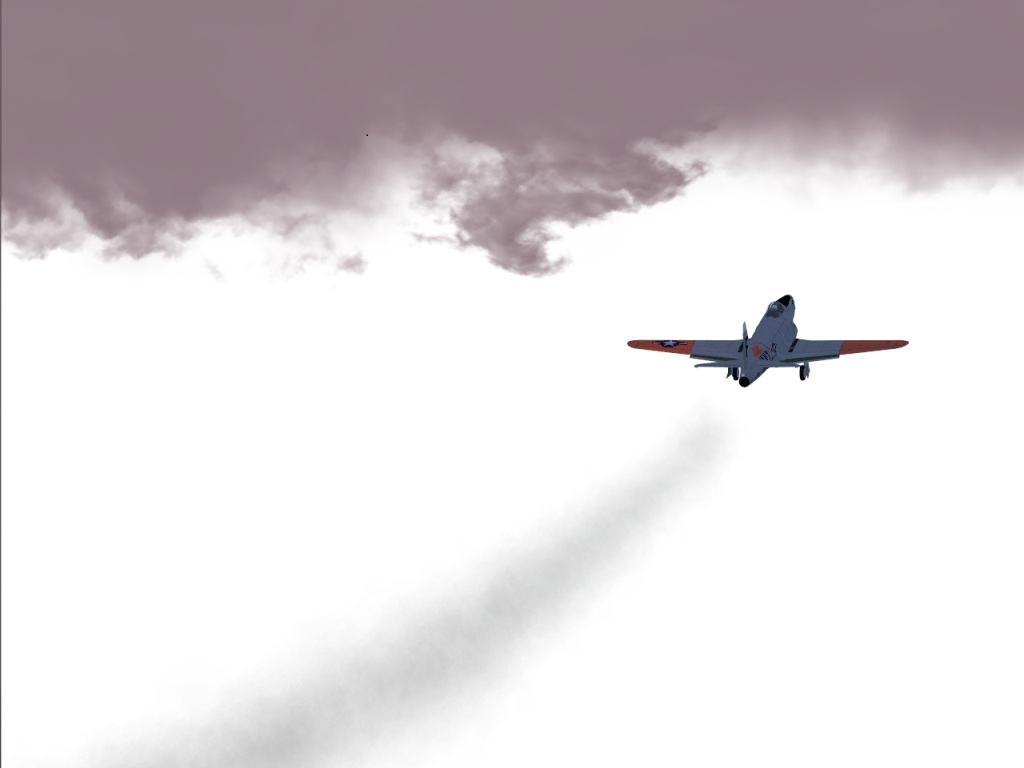
The Lockheed P-80 Shooting Star was the first jet fighter used operationally by the United States Army Air Forces, and saw extensive combat in Korea with the United States Air Force as the F-80. As one of the world's first successful turbojet-powered combat aircraft, it helped usher in the "jet age" in the USAF and other air forces worldwide. One of its claims to fame is in training a new generation of pilots, especially in its closely-related T-33 Shooting Star trainer development.
The Shooting Star began to enter service in late 1944 with 12 pre-production YP-80A's one of which was destroyed in the accident that killed Burcham. A thirteenth YP-80A was modified to the sole F-14 photo reconnaissance model and lost in a December crash. Four were sent to Europe for operational testing (two to England and two to the 1st Fighter Group at Lesina Airfield, Italy) but when test pilot Major Frederic Borsodi was killed in a crash caused by an engine fire on 28 January 1945, demonstrating YP-80A 44-83026 at RAF Burtonwood, the YP-80A was temporarily grounded. Because of the delay the Shooting Star saw no combat in World War II.
The initial production order was for 344 P-80As after USAAF acceptance in February 1945. Eighty-three (83) had been delivered by the end of July 1945 and 45 assigned to the 412th Fighter Group (later redesignated the 1st Fighter Group) at Muroc Army Air Field. After the war, production continued, although wartime plans for 5,000 were quickly reduced to 2,000 at a little under $100,000 a copy. A total of 1,714 single-seat F-80A, F-80B, F-80C and RF-80s were manufactured by the end of production in 1950, of which 927 were F-80Cs (including 129 operational F-80As upgraded to F-80C-11-LO standards). However, the two-seat TF-80C, first flown on 22 March 1948, became the basis for the T-33 trainer, of which 6,557 were produced.
The P-80B prototype, modified as a racer and designated XP-80R, was piloted by Colonel Albert Boyd to a world air speed record of 623.73 mph (1,004.2 km/h) on 19 June 1947. The P-80C began production in 1948; on 11 June, now part of the United States Air Force, the P-80C was officially redesignated the F-80C.
The USAF Strategic Air Command had F-80 Shooting Stars in service from 1946 through 1948 with the 1st and 56th Fighter Groups. The first P-80s to serve in Europe joined the 55th Fighter Group (later redesignated the 31st FG) at Giebelstadt, Germany, in 1946, remaining eighteen months. When the Soviet Union blockaded Berlin, a squadron of the 56th FG led by Colonel David C. Schilling made the first west-to-east Atlantic crossing by single-engined jets in July, flying to Germany for 45 days in Operation Fox Able I.[6] Replaced by the newly F-80-equipped 36th Fighter Group at F