Page 1 of 6
Debate!

Posted:
Sun Jan 14, 2007 6:07 pmby EGNX
Somebody asked me this question today, and then eventually told me the answer... lets see what you can come up with...
Will it or wont it take-off???Heres the situation:
For ease, lets say that a Boeing 747 is lined up a very long (many, many miles) conveyor belt type device, that counteracts the movement of the aircrafts wheels as they move. But as the aircraft speeds up will it ever take-off? Yes or no and why?
Artist impression: But will that really happen?
(This is just something to represent the concept, don't let it distract you from the question)
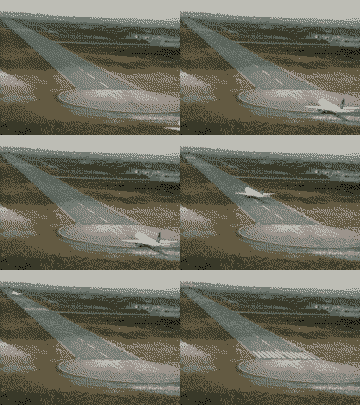
Diagram:

Re: Debate!
Posted:
Sun Jan 14, 2007 6:09 pmby EGNX
And by the way if you have heard of this question before, don't give out the answer and spoil it for the others. Just feel smug in knowing that you know.... ;)
Re: Debate!
Posted:
Sun Jan 14, 2007 6:13 pmby Craig.
we have had this before in simv. went many pages despite the answer being posted by several of us on page 1 lol

Re: Debate!
Posted:
Sun Jan 14, 2007 6:15 pmby EGNX
So what is your answer???
Re: Debate!
Posted:
Sun Jan 14, 2007 6:19 pmby Craig.
i am keeping out of it as I was the first or second to post what was decided as the correct answer.
Re: Debate!
Posted:
Sun Jan 14, 2007 6:21 pmby EGNX
Personally what do you think....?
Re: Debate!
Posted:
Sun Jan 14, 2007 8:31 pmby VVM
i dont know the actual answer to this...but i think that yes it would take off as the wheels of the aircrat dont have anything to do with how fast it goes. the power is not fed to the wheels like a car.
Re: Debate!
Posted:
Sun Jan 14, 2007 8:39 pmby Jakemaster
No, that is so stupid! Its not a car, it doesnt need its wheels to go, it needs AIR SPEED! For a plane to fly it needs air to move over the wings, THATS why it needs a long runway, so that it can accelerate to a high enough velocity for enough air to flow over the wing and produce lift.
If you put a giant fan in front of the runway, then that could be plausible, but a conveyer belt is stupid.
If the belt moves at the same speed as the plane needs to move to take off, the plane would have to get to a speed twice as fast as normal, and that would take more power than it has, or at least a lot more time than the engines could run at takeoff thrust.
EDIT: I just reread the post, and I must say I don't understand what is being asked?
Re: Debate!
Posted:
Sun Jan 14, 2007 8:44 pmby expat
Bearing in mind it is 02:30 in am very early AM, here is my input.
It is not a question of wheel speed. If the aircraft is at max thrust forward and the conveyor matches the aircrafts speed in the opersite direction, then the aircraft will be stationary and not producing any airspeed to produce lift. Effectively it is on a rolling road and if you put a car on a rolling road and put you hand out of the window you feel nothing. Your wheels may be rotating at a lift off speed, but you are not actually moving.
Matt
Re: Debate!
Posted:
Sun Jan 14, 2007 9:51 pmby PsychoDiablo
[quote]Bearing in mind it is 02:30 in am very early AM, here is my input.
It is not a question of wheel speed. If the aircraft is at max thrust forward and the conveyor matches the aircrafts speed in the opersite direction, then the aircraft will be stationary and not producing any airspeed to produce lift. Effectively it is on a rolling road and if you put a car on a rolling road and put you hand out of the window you feel nothing. Your wheels may be rotating at a lift off speed, but you are not actually moving.
Matt
Re: Debate!
Posted:
Sun Jan 14, 2007 10:25 pmby Papa9571
Your question and your diagram conflict. If the conveyor is set to counter act the movement of the wheels, or put another way, to prevent the wheels from turning, the aircraft will take off with minimum thrust. This is because as the aircraft moves, the conveyor will move adding it motion to that of the aircraft. once sufficient lift is achieved the aircraft will take off.
If the conveyor is set to counteract the movement of the aircraft, the aircraft will still achieve flying speed though it will take longer. Thrust from the engines is applied to the aircraft, not the wheels. The wheels allow the aircraft to move, turn, and stop while on the ground. The conveyor would accelerate to attempt to keep the aircraft in place but would not be successful. The aircraft will still reach flying speed.
Re: Debate!
Posted:
Sun Jan 14, 2007 10:30 pmby Helms
Looks like the plane takes off at the end of the little animation, so there you go.
Re: Debate!
Posted:
Mon Jan 15, 2007 12:26 amby Mobius
Because the aircraft thrust is provided through the jet engines, and not the wheels, it absolutely will take-off. The engines thrust is independent of the wheels. The engines will still work the same way, and will produce the same thrust. The thrust force of the engines still pushes on the surrounding air and the airframe just as it would if there were no conveyor. The wheels really have nothing to do with the speed or thrust of the aircraft on takeoff, they just provide a means to reduce the friction between the aircraft and the earth. See my picture below:
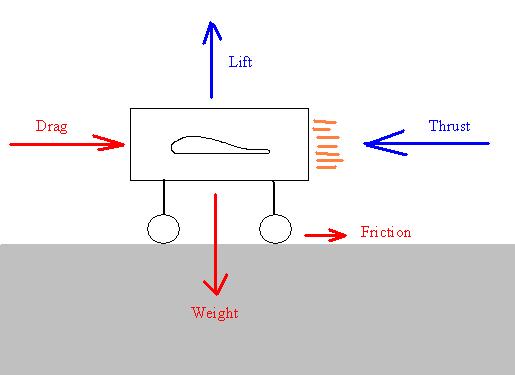
This is a (very) simple free body diagram showing all the forces present on an aircraft as it rolls down the runway. All the forces acting during cruise flight (thrust, drag, lift, and weight) are all present, along with the friction caused by the contact between the wheels and the ground, and any friction in the individual components of the landing gear. The only thing that would be affected if a conveyor was used, would be the friction force due to the contact between components in the landing gear, which would really not affect the overall speed of the aircraft. All the other forces would still be present and would still lead to flight, as long as the thrust and lift were sufficient to overcome the drag (and friction) and weight.
It's similar to saying if there was a 200 mph wind blowing straight down the runway and the aircraft was not moving (relative to the ground), would the aircraft take off? Even if the wheels weren't spinning? What if the aircraft was on a conveyor with a 200 mph headwind? You can see that the wheel speed is independent of the airspeed.

Re: Debate!
Posted:
Mon Jan 15, 2007 12:46 amby Conan Edogawa
My very personal opinion:
It would make the way of the aircraft (which it uses to take off) very longer, because the wings don't have any airspeed, only the wheels are moving in fact.
Nice GIF by the way...
Re: Debate!
Posted:
Mon Jan 15, 2007 1:06 amby RitterKreuz
well think about this... the aircraft needs airspeed to generate lift... during the ground roll the 747 would have to increase speed to about 150 kts AIRSPEED (relative to ambient air NOT the tradmill) in order to lift off. The treadmill is irrelevent. except to say how fast is the treadmill rolling along? 150 knots? so if you hooked a speedometer to the tires the speed of the tires in relation to the treadmill would be about 300 kts when the airspeed is 150 knots- the aircraft could then lift off and fly regardless of the tire speed or the treadmill speed.
One problem... the tires of a 747 are speed rated to about 263 knots, depeding on the speed of the treadmill the tires would explode some time prior to the aircraft reaching Vr... but assuming this is irrelevant and your tires are invencable then yes you could still reach Vr and lift off.
