Page 1 of 2

Aurora time lapse

PostPosted: Sun Oct 15, 2006 5:25 pm
by flyboy 28

Re: Aurora time lapse

PostPosted: Sun Oct 15, 2006 9:42 pm
by Jakemaster
I need to go to Alaska...

Re: Aurora time lapse

PostPosted: Sun Oct 15, 2006 10:45 pm
by Mobius
That was fantastic.  Luckily we get to see one display like that once every five or so years here, and the last one was this time of year almost two years ago.  So, I went out by the airport here and layed on the sidewalk for two hours at midnight watching streams of green whipping across the skies from horizon to horizon, north to south, east to west.  Everybody thought I was absolutely nuts, but I still look back on that night as probably the most amazing natural phenomenon I have ever witnessed, and I hope to see it again.

If anyone is interested, HERE is a current Aurora forcast/activity page from NOAA. ;)

Re: Aurora time lapse

PostPosted: Sun Oct 15, 2006 11:02 pm
by Travis
So why do some of the stars in the background remain stationary, while the rest move?

I can't believe there are that many geosynchronous satellites in orbit over Alaska.  All those stars should move together, since there are times that stars with motion pass directly over stationary ones.

What the hell?

Re: Aurora time lapse

PostPosted: Mon Oct 16, 2006 1:01 pm
by Tweek
So why do some of the stars in the background remain stationary, while the rest move?

I can't believe there are that many geosynchronous satellites in orbit over Alaska.  All those stars should move together, since there are times that stars with motion pass directly over stationary ones.

What the hell?


Well if you look at an object close to you, but also look at an object far away, then step to the side, it will look like the nearest object has moved further in your line of sight.

Same thing with the stars. The ones which appear to move faster, are closer to the Earth.

Re: Aurora time lapse

PostPosted: Mon Oct 16, 2006 1:21 pm
by 61_OTU

Well if you look at an object close to you, but also look at an object far away, then step to the side, it will look like the nearest object has moved further in your line of sight.

Same thing with the stars. The ones which appear to move faster, are closer to the Earth.


???

I've not watched the video.....but I'm pretty sure you're wrong in your statement Tweek.

If what you say is correct the constellations would not appear fixed from our perspective from earth, they would change shape.

Someone google astrophysics and  post some text.......

Re: Aurora time lapse

PostPosted: Mon Oct 16, 2006 1:32 pm
by Tweek
I've not watched the video.....but I'm pretty sure you're wrong in your statement Tweek.

If what you say is correct the constellations would not appear fixed from our perspective from earth, they would change shape.


Hmm, good point.

Have a look at the video, though, to see what he means by it. Maybe there's a different (correct) explaination for it!

Re: Aurora time lapse

PostPosted: Mon Oct 16, 2006 4:12 pm
by Mobius
Yeah Tweek, that's wrong, all the stars move together.  What you're talking about is parallax, and you can't notice the parallax from one star to another (at least without very expensive telescopes and instruments), because they are all so far away. The only thing you would really notice (but very very little) would be the moon as it revolves around the earth, and if it was a really long time-lapse the planets would move, as would the sun, asteroids, etc., but the background of stars really doesn't move (in anyone's lifetime, they do move over thousands and hundreds of thousands of years though).  But as far as the specks go, they can't be satellites, because you can't see satellites at midnight (they're in shadow), so I would expect them just to be specks on the camera or reflections from the city lights, or something else, I don't know.  ;)

Re: Aurora time lapse

PostPosted: Mon Oct 16, 2006 4:27 pm
by Alonso
:o :o :o :o :o :o :o :o :o :o :o :o :o :o :o :o :o :o :o :o :o

the equatorRe: Aurora time lapse

PostPosted: Mon Oct 16, 2006 7:49 pm
by Brett_Henderson
Don't the stars "move" across the sky.. just like the sun does ?

I mean.. a star that would be on a line from the Earth's center to the equator would "move" the most.. And stars on lines more parallel the Earth's axis move less. It's why the North Star is always north.. right ?

edit:  nevermind.. I get it now   :-[   They still move as a group and not distinguishably separate ...

Re: Aurora time lapse

PostPosted: Tue Oct 17, 2006 2:25 pm
by 61_OTU
Ok, I've watched it now, and I can see the background of the constellations appear to be revolving slowly anti-clockwise.

The apparent centre of the revolutions is where the pole star is to be found. The Pole star does not appear to move in the northern hemisphere as it lies directly above the earth's current rotational axis. It is the rotation of the earth which makes the stars appear to move.

The bright whizzy lights which go all over I assume to be planes, the very fast straight whizzy lights are either meteors (shooting stars, unlikely as they would probably travel too fast for the time lapse photography to capture in more than one frame) or satellites of the man made weather/spy kind.

I don't know about not being able to see satellites at midnight:

But as far as the specks go, they can't be satellites, because you can't see satellites at midnight (they're in shadow),


not sure I agree with that Mobius, and who says this footage was taken at midnight anyway? I've seen satellites pretty late at night tracking slowly across the sky, they seem like the most likely explanation to me.
Re: Aurora time lapse

PostPosted: Tue Oct 17, 2006 3:50 pm
by Mobius
not sure I agree with that Mobius, and who says this footage was taken at midnight anyway? I've seen satellites pretty late at night tracking slowly across the sky, they seem like the most likely explanation to me.

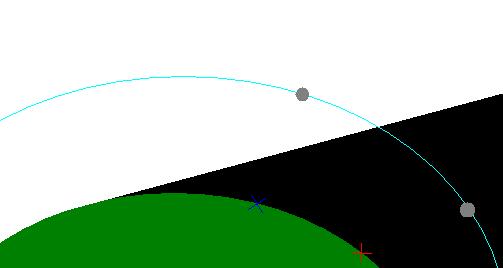
It's like a lunar eclipse, but since the satellites are so close to the earth, they travel throught the earth's shadow, so no light is reflected off of them once they are past the edge of the earth's shadow (umbra).  Imagine seeing a really high cloud at night, at dusk you can still see the cloud illuminated by the sun even if you are in the dark (the earth's shadow), but in the middle of the night, that cloud isn't illuminated (assuming a new moon, or close to new moon), because the earth is blocking the light from the sun that would reflect off the cloud/satellite.  For example, in this diagram...

Image

The earth is the green thing, the portion of space illuminated by the sun is the white area, the earth's shadow is the black area, at dusk you are at the blue 'x', and later in the night you are at the red 'x', and the satellite is the grey blob, following it's blueish colored orbit.  So at dusk, you may be in the earth's shadow, which makes it dark, but the satellite that's a couple hundred miles over your head is still in the sunlight, so you can see it's reflected light, even though you are in the dark, but as the satellite continues in it's orbit, it passes from the light into the shadow, and it's no longer reflecting light for you to see.  So in the middle of the night, all the satellites over head are in the shadow, so you can't see them becuase there isn't any light to reflect back to your eyes.

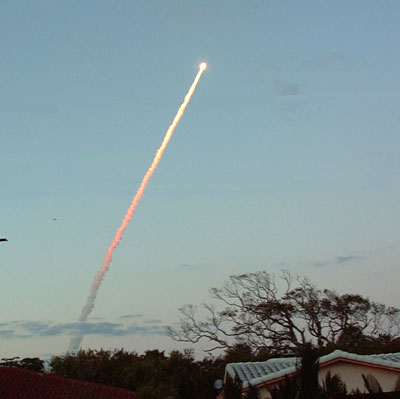
Here's a cool picture that illustrates that dark to light transition.  It's a rocket taking off at dawn, while still in the dark, and passing into the sunlight before the ground is illuminated...

Image

;)

Re: Aurora time lapse

PostPosted: Tue Oct 17, 2006 4:08 pm
by 61_OTU
It's like a lunar eclipse, but since the satellites are so close to the earth, they travel throught the earth's shadow, so no light is reflected off of them once they are past the edge of the earth's shadow (umbra).


A good explanation, but that doesn't discount the possibility that these are satellites, just that the footage was taken at midnight. Does it say anywhere that the footage was taken so late or is it reasonable to assume that the footage was taken at a time when the satellite would have been visible within the penumbra?

Re: Aurora time lapse

PostPosted: Tue Oct 17, 2006 5:13 pm
by Mobius
It's almost the entire night it looks like, the sun sets at the very beginning, and then you can track the stars as they move through the night.  Since they should move through a half a revolution around the north star in a period of 12 hours, I think it's pretty safe to assume that the footage is taken throughout most of the night. ;)

Re: Aurora time lapse

PostPosted: Tue Oct 17, 2006 10:36 pm
by Travis
Okay, well, they don't move.  To prove it, place the tip of your mouse cursor over one of the lights (a good one is the blue one at the top-left) and then leave it there as the video plays.  See?  No movement.