Page 1 of 1
autopilot question

Posted:
Sun Sep 24, 2006 7:14 amby VVM
hi all. after a lot of practice, i have finally mastered landing whilts manually adjusting the throttle and pitch/altitude of my a/c. however, when on approach using the approach function, i am finding that the autopilot is continually triming the elevator up until i turn the autopilot off, even when i am not using the altitude hold. does anyone know why this is happening. if i have not explained this very well say so and ill try to re-word it

cheers

Re: autopilot question
Posted:
Sun Sep 24, 2006 7:44 amby commoner
...not too clear what you are trying to do here vav..........are you attempting an ILS approach, if so have you tuned in to the ILS frequency of the runway and are you approaching the runway from the right end..........and do you have the Nav/GPS switch to nav..........

???
..........or are you expecting something else from simply having the Appr. button selected?
..............more precise explanation would be helpful............commoner.
There are some great tutes on ILS approaches around and if that is what you want then we could probably find you one...........

Re: autopilot question
Posted:
Sun Sep 24, 2006 8:13 amby VVM
yeh i read it through after typing it and it is a bit difficult to understand. so here i go again

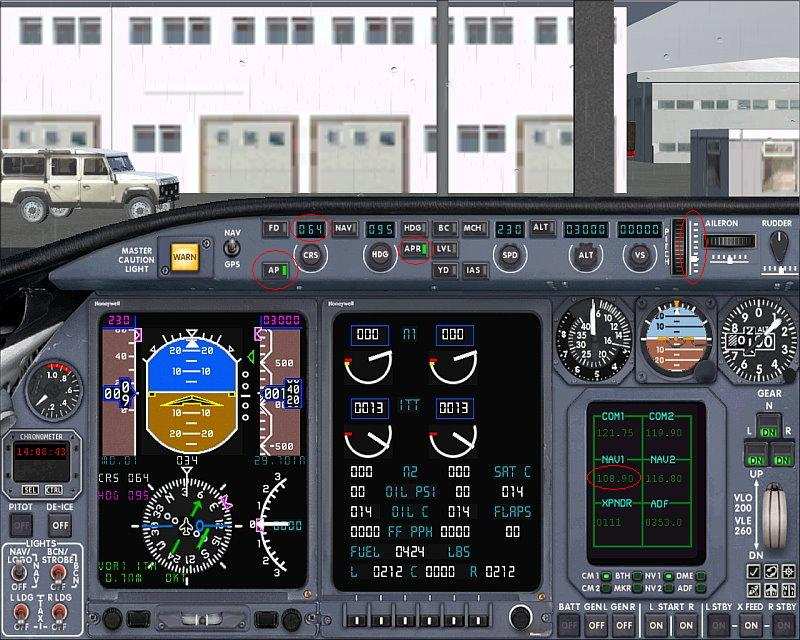
right, assume that i am on an ils approach in the pic, i have the 'auto pilot' master switch on and the 'approach hold' switch on. i have the runway heading in the course selctor and the ils frequency in the nav 1 radio.
now, what is happening is that the auto pilot is continually triming the elevator up, and i am continually having too trim down so i dont stall. (making sence so far?) the auto pilot only stops trimming up when i turn it off about as i get close enough too land fully manual.
should i have the flight director switch selected instead of the auto pilot master switch?
Re: autopilot question
Posted:
Sun Sep 24, 2006 8:33 amby TSC.
What plane are you sing Vav?
Assuming that you have intercepted the glide-slope & the AP has taken control of the approach for you - what speed are you approaching at & what flaps settings are you using? - if your KIAS is too slow to retain altitude then the AP will be constantly trimming up in order to stay with the glide-slope - which will result in a stall.
Cheers,
TSC.
Re: autopilot question
Posted:
Sun Sep 24, 2006 8:49 amby VVM
aircraft: erj-145
approach speed: 140-145kts
flap setting: full (on this occasion)
it happens with all the aircraft, not just this one. the other example i can think of is:
aircraft: 757-200
approach speed: 155-160kts
flap setting: 1 notch off full
Re: autopilot question
Posted:
Sun Sep 24, 2006 9:01 amby TSC.
Don't suppose you've got teamspeak Vav? This might be easier to solve with a bit of an MP at the airport your using.
Cheers,
TSC.
Re: autopilot question
Posted:
Sun Sep 24, 2006 9:12 amby VVM
nah i dont have it. im going just going too fly from edinburgh to london ciyt and see what happens on my approach this time.
Re: autopilot question
Posted:
Sun Sep 24, 2006 10:02 amby Brett_Henderson
The approach-hold, is a 2-axis deal. The A/P will trim the elevator to keep you on the glide-scope (unless it's a localizer only ILS)..
I don't fly jets often, but I've found that if you let the A/P fly the approach; it's best to fly it a little faster than you would manually. The A/P will trim your airspeed away before you know it.. lol
I've never tried flying an ILS using only the nav-hold. If it works.. that would leave pitch/airspeed completely up to you.
Re: autopilot question
Posted:
Sun Sep 24, 2006 11:49 pmby Nav
vavavoom, as in a real aeroplane, you can TEMPORARILY override the autopilot with the manual controls. But if you leave the A/P switched on (especially if it's in 'Approach Mode'), as soon as you stop making a given manual input, it will set to work to bring the aeroplane back to the normal approach path.
Trick is progressively to turn off the auto controls as you close in - first the 'Speed Hold,' then the 'Approach Mode' - and take full manual comtrol for the final landing phase. Explained in here, with screenshots:-
http://www.simviation.com/cgi-bin/yabb/YaBB.cgi?board=COF;action=display;num=1111322151
Re: autopilot question
Posted:
Mon Sep 25, 2006 1:57 amby eno
Sounds like you're too heavy and too slow..... the heavier your aircraft (fuel wise) the faster the approach speed. If not then you'll stall.
Re: autopilot question
Posted:
Mon Sep 25, 2006 2:24 amby commoner
...mmmm...Yes..........overloaded with fuel spoiled my enjoyment of FS for years ..........don't know why it took me so long to realise it, but when I did it changed my life...........it's a real killer especially taking off and landings with the "biggies".............commoner
Re: autopilot question
Posted:
Mon Sep 25, 2006 6:43 amby vololiberista
The only reason your AP is continually trimming nose up is that it is trying to increase the angle of attack in order to increase lift as your airspeed falls off! Your problem is a combination of too low an airspeed and incorrect use of flaps.
Your scenario is that you under IFR - ATC will call you to give you a heading and descent to an altitude at which you can intercept the localiser. Let's say you are at FL70 you are doing 210kts IAS ATC says "Turn left heading 335 degrees, descend to 2,500ft call established 27 left"
So now you reduce your speed to 180 IAS and select first stage flaps. DO NOT allow the a/c to run away (if necessary use the speed brakes until you arrive at your interception altitude). When you reach 2,500ft you should select your AP to follow the localiser and glide slope. You will intercept the glide slope at about 8nm from the threshhold so at this point - gear down, second stage flaps, drop the speed back to 160 IAS (if your a/c has 4 flap settings select 3rd stage flaps when the a/c arrives at 160 IAS) As you pass the outer marker or 4nm out select full flaps speed down to 140 IAS as you cross the threshhold at screen height your speed should be 130 IAS now you can throttle back and land. Add 5kts to all your airspeed settings below 180 IAS to account for turbulence or crosswinds.
These speed settings will be accepted by all jets and most turbo props. Correct use of flaps and airspeed will ensure your problem goes away.
Buoni Atterraggi
Vololiberista
Re: autopilot question
Posted:
Mon Sep 25, 2006 2:40 pmby garymbuska
I hardly ever use the approach button as I all ways turn off the auto pilot once I get a visual of the airport. If you watch your nav1 gauge it will let you know when you get close to the glide slope and which way it is. But you have to watch your airspeed and flap settings as well as know the weight of the aircraft so you do not create damage due to high speeds. You have to rember that flaps will give you more lift but increase drag which will slow you down so you have to use the throttle to maintain air speed.
Re: autopilot question
Posted:
Mon Sep 25, 2006 3:53 pmby vololiberista
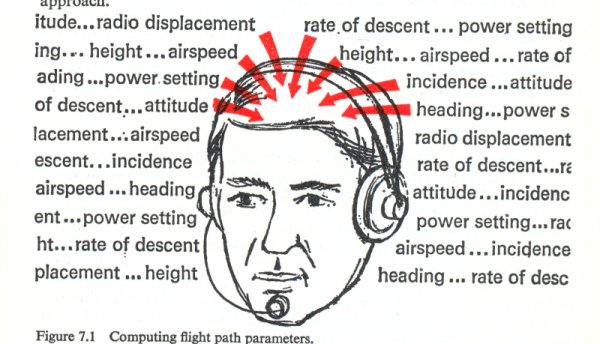
Weight and balance are crucial for safe flying. On an approach to land weight and balance will dictate your stall speeds. In the real world ATC will issue speed advisories on approach and these MUST be adhered to as they are for a/c separation and traffic flow. FS9 and also as far as I know FSX ATC do not issue speed advisories so you the pilot must assume they have been given. Regardless of your weight the speed profile I have described above WILL get you down safely. But, you as a pilot (armchair or real) will have to take into account wind speed, direction, air temperature, weather conditions, airfield elevation and a/c performance. These all add or subtract to the margin of safety provided by the reference speeds. This illustration below gives a good idea how busy you'll be!!!
Vololiberista
Re: autopilot question
Posted:
Mon Sep 25, 2006 4:21 pmby Nexus
Meh..piece of cake....