 by RollerBall » Thu Mar 24, 2005 7:04 pm
You never enter the ILS phase of your flight while you're still descending. It's very important that you intercept the Glide Slope from below so you will always therefore be at a height of something like 2000-2300 ft above airport elevation in a level attitude.
The following is pretty typical for an ILS approach.
Either you will be taking instructions from ATC or you will be using an approach chart (preferably) or just the GPS to get yourself into the right position. ATC will do all of the working out for you and just give you instructions to descend when necessary and the headings to fly. But let's say you're doing it for yourself.
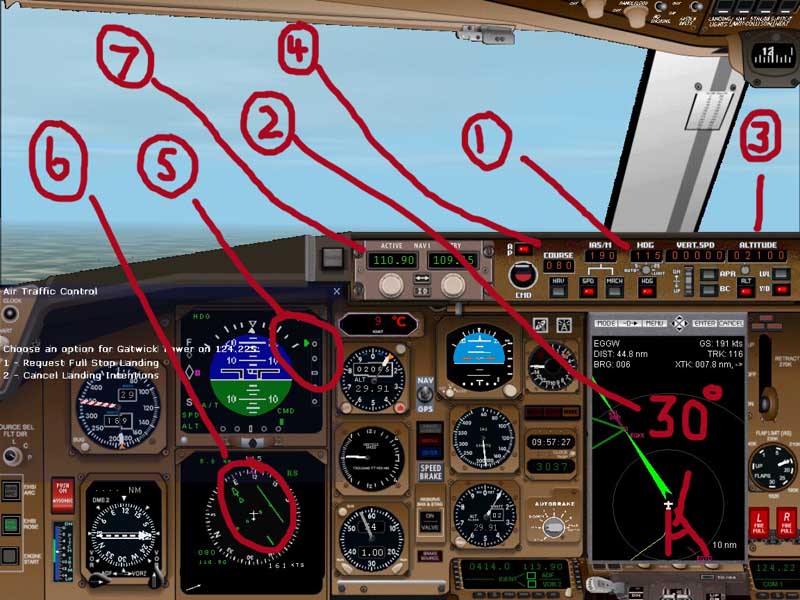
You're aiming to be at say 2100ft (therefore flying at quite a bit less than 250 kts and probably with 1 or 2 notches of flap on depending on what you're flying) flying towards the runway centre line on a relative angle of 30 deg off it. So if the runway heading is 300 deg, depending on which direction you're approaching from, you'll be either on 270 deg or 330.
You'll have 2100 ft cranked into your AP with ALT hold on. You'll have say 270 in the HDG box with HDG hold on. You'll have 300 deg in the CRS box ready for final approach and the ILS frequency set in NAV1.
The aircraft is flying under full AP control assuming you have autothrottle. If not, you are controlling the speed manually and applying flaps as required as you slow down.
You're now watching the ILS bars. In the scenario described the Localiser bar will be skewed off to the right, showing that the extended runway centre line is off to your right ie when you get onto it you will therefore have to turn LEFT onto the runway heading. The GS bar will be up on the top of the gauge showing that the GS line is above us. This is essential. If it isn't, you abort the approach and go around. You're probably now at something like 30-35 nm DME from touchdown.
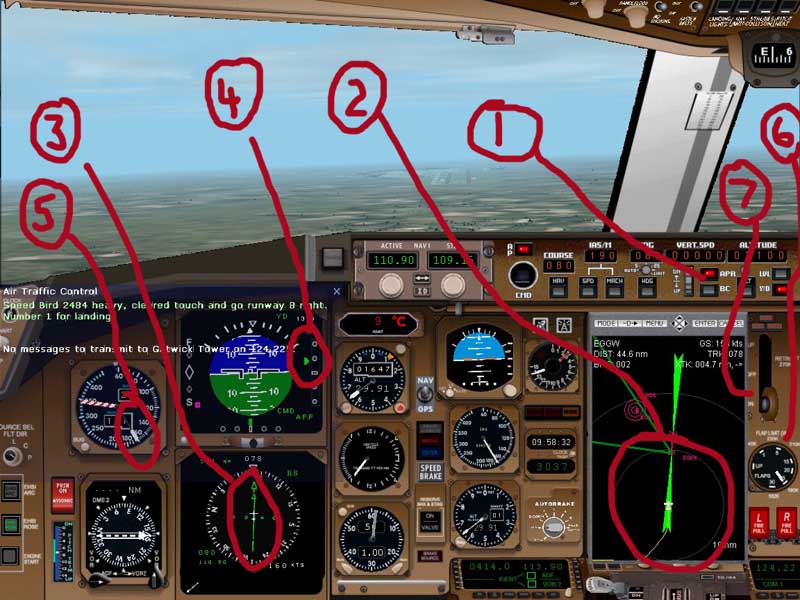
You're watching the Localiser bar like a hawk and waiting for the first sign of movement back towards the centre of the gauge. This will probably happen at around 20-25 nm DME from touchdown. When it does, this is called being ESTABLISHED on the Localiser. In real life you will report 'Established Localiser' to Approach ATC.
As soon as you are established, you hit the APR button on the AP. HDG will go out and soon the plane will begin to gently bank (unfortunately it can be quite fierce in the sim and it can take 2 or 3 wiggles for the plane to get set up on the centre of the Localiser beam.
Now it just leaves the GS. What do you do? Nothing. You leave ALT hold on. You did all you had to by making sure you were below the GS beam right at the start of the procedure. You watch the GS bar descending on the gauge and when it reaches the centre you will see ALT hold go off and the plane will begin to descend. Now all you will need to do is control speed, add flap, make sure you get the gear down and monitor the approach.
At 1000-1500 feet (if not sooner actually) you'll take manual control of throttles. Approaching Kai Tak, for example, CX Jumbo Captains took AT off at around 10 miles or so out. At say 500 ft you come out of AP completely and take manual control for the flare and landing.
A few guys around here who may not be comfortable with controlling their aircraft via the AP say 'I always approach and land manually - much nore fun'. But they're wrong. It's just as much fun to have complete control of the aircraft systems and know that you can do it all confidently and smoothly. It's not as easy as all that as you've found.
Also you don't get many heavies being landed manually in real life by gung ho jockeys in minimal visibility so if you can't do it like the real pilots do, you're not really cutting it, are you ;)



 PhotoShop 7 user


 "In theory, there is no difference between theory and practice. But, in practice, there is."