Hmmm...you're an 'old hand', commoner, not sure there's anything I can teach you. Maybe one thing I learned about flying, though, in my youth. At a guess, you find that you have to 'fiddle around' because she keeps sagging below the glidepath, not the other way around?
I started off flying gliders. You probably know that they are the opposite of powered aeroplanes in many ways. They are designed to stay UP; so, instead of being worried that they may drop like a stone, you spend a lot of your time trying to persuade the things to go down at all........
This rubbed off on my flying when I tried powered aircraft. I tended to cut the power too early and too much, and the aeroplane used to 'sag'. I still recall my instructor saying, "BLOODY glider pilots. Give her some oomph to work with! I'm not going to charge you any less because you save me half-a-pint of fuel - especially if we stall in......."
Finally I 'saw the light'. An aeroplane can 'absorb' a little too much power on approach - you or the A/P trim the nose a bit lower, and it turns the power into speed. But too LITTLE power, and the nose pitches higher and higher up, you start losing airspeed, and the rate of descent increases.......
Tried landing both the Skylane and the 747 in your honour. Both of them had a fair amount of fuel on board - so they were heavier than they would have been after a long trip. For the Cessna, I kept the speed above 75 knots, for the 747 at about 155 knots, to compensate for the weight.
Hey presto - both of them stayed on the glidepath. Here's a picture of the Skylane, with the A/P engaged, holding exactly to the glidepath, 'hands off'. With the speed up towards 80 knots.
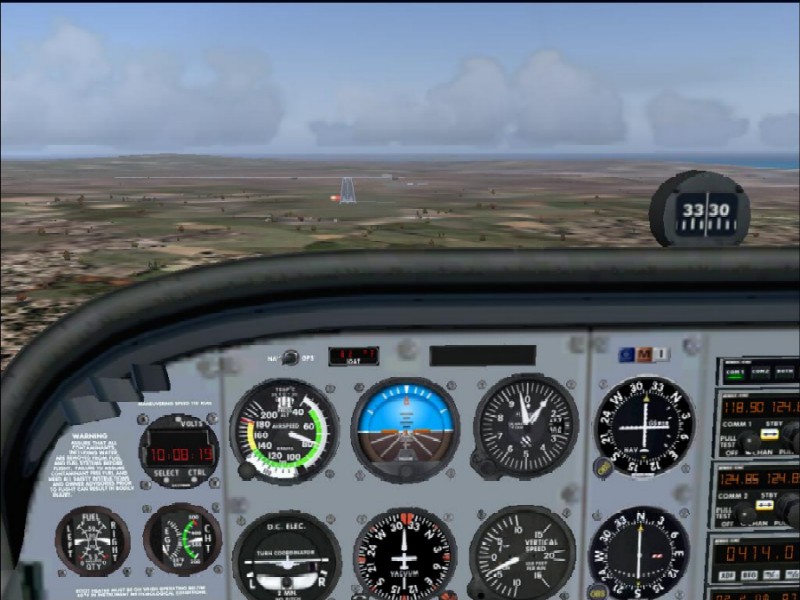
You can always lose the extra few knots as you flare. So the moral is, if in doubt, give her a little MORE power than she needs - and a little more than the 'book' says. Never a little less.
 Posted: Fri Mar 11, 2005 11:52 pm